

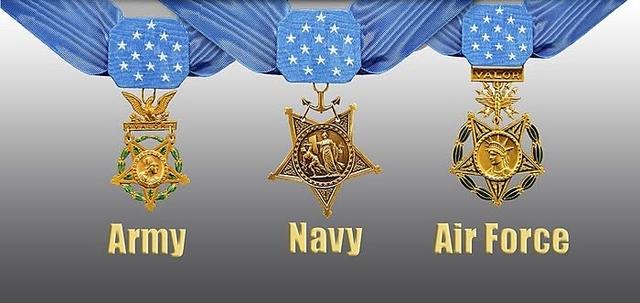
Medal of Honor
The nation's highest military decoration
The Medal of Honor is the nation's highest medal for valor in combat that can be awarded to members of the armed forces.

The medal was first authorized in 1861 for Sailors and Marines, and the following year for Soldiers as well. Since then, more than 3,400 Medals of Honor have been awarded to members of the Department of Defense services and the Coast Guard.
Medals of Honor are awarded sparingly and are bestowed only to the bravest of the brave. That courage must be well documented.
The Full Story
During the first year of the Civil War, Lieutenant Colonel Edward D. Townsend proposed a battlefield decoration for valor to Lieutenant General Winfield Scott, the commanding general of the United States Army. Scott opposed the European tradition of military medals, but after he retired in October 1861, Secretary of the Navy Gideon Welles adopted the idea for distinguished naval service.
On December 9, 1861, Senator James W. Grimes introduced the naval Medal of Honor provision in Bill S. 82. Congress passed it and President Abraham Lincoln signed it into law. The Navy ordered its first medals from the Philadelphia Mint in 1862, with Personal Valor inscribed on the reverse.
Senator Henry Wilson introduced the Army resolution in February 1862. Congress approved it in July, and the Army's version was produced later that year. On March 3, 1863, Congress made the Medal of Honor a permanent decoration and authorized it for Army officers. Later redesigns helped distinguish it from other military insignia, while a 1917 review removed medals that had been awarded improperly and later reviews restored some of them.
A separate Coast Guard Medal of Honor was authorized in 1963, and an Air Force design was authorized in 1960 and adopted in 1965.
